How to Save for a Car While Paying Rent
By Pennie at FiscallyAI • Updated • 11 min read
I’m Pennie, and saving for a car on a renter’s budget is totally doable
Rent eats a huge chunk of your income. Saving for a car on top of that feels impossible. But with a dedicated sinking fund, realistic expectations about what car to buy, and a clear timeline, you can get there without taking on a scary car loan. Let me show you the math.
The Strategy
Open a dedicated car sinking fund. Automate $150-400/month. Target a reliable used car at $8,000-15,000. Pay cash if possible, or put 20% down with a 48-month loan maximum. Total car costs should stay under 15% of your take-home pay.
The Rent + Car Savings Challenge
If you’re like most renters in your 20s, rent takes 30-40% of your income. After utilities, food, insurance, and other essentials, there’s not much left. Saving thousands of dollars for a car seems unrealistic.
But here’s the thing: a car payment on top of rent is often worse than saving up first. A $400/month car payment for 5 years means you’ll pay $24,000 for a car that might be worth $10,000 when you’re done. Save that same $400/month for 12-18 months and buy something reliable outright, and you skip the interest entirely.
The key is a system: a dedicated savings account, an automatic transfer, and clear targets.
Step 1: Figure Out What Car You Can Actually Afford
Before you save a dollar, decide what you’re saving for. The biggest mistake is targeting a car that’s too expensive for your income.
The 15% Rule
Your total monthly car costs — payment (or savings contribution), insurance, gas, and maintenance — should be under 15% of your monthly take-home pay.
| Monthly Take-Home | 15% Car Budget | Realistic Car Price |
|---|---|---|
| $3,000 | $450 | $8,000-12,000 |
| $3,500 | $525 | $10,000-15,000 |
| $4,000 | $600 | $12,000-18,000 |
| $4,500 | $675 | $15,000-22,000 |
| $5,000 | $750 | $18,000-25,000 |
The “realistic car price” column assumes you’re buying with cash or a modest down payment. Insurance ($100-200/month for a younger driver), gas ($100-200/month), and maintenance ($50-100/month) eat into that 15% too.
Step 2: Set Up a Car Sinking Fund
A sinking fund is money you set aside each month for a specific future expense. It’s different from your emergency fund — this money has one job: buying a car.
How to set it up:
- Open a separate high-yield savings account (many are free and earn 4-5% APY).
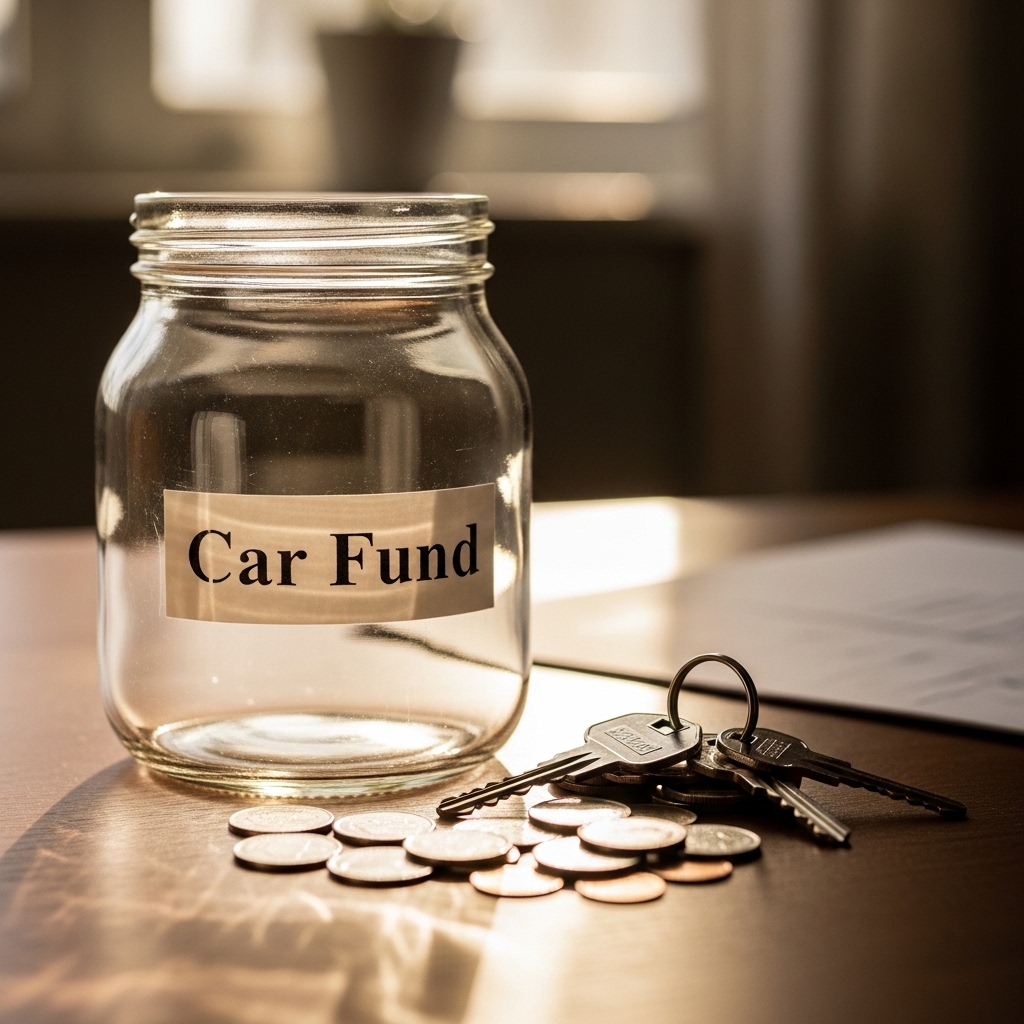
- Name it “Car Fund” (most online banks let you nickname accounts).
- Set up an automatic transfer on payday.
- Don’t touch this money for anything else.
The automatic transfer is critical. If you have to manually move money each month, you’ll skip it when rent week feels tight. Automation removes the temptation.
Step 3: Calculate Your Timeline
How long it takes depends on your target and monthly savings:
| Monthly Savings | 6 Months | 12 Months | 18 Months | 24 Months |
|---|---|---|---|---|
| $150 | $900 | $1,800 | $2,700 | $3,600 |
| $200 | $1,200 | $2,400 | $3,600 | $4,800 |
| $300 | $1,800 | $3,600 | $5,400 | $7,200 |
| $400 | $2,400 | $4,800 | $7,200 | $9,600 |
| $500 | $3,000 | $6,000 | $9,000 | $12,000 |
These numbers don’t include the interest you’ll earn in a high-yield savings account (add another 4-5% annually). They also don’t include any windfalls — tax refunds, bonuses, or side hustle income — that can accelerate the timeline.
A realistic target for most renters: $200-300/month for 12-18 months, giving you $3,600-5,400 for a cash purchase or a solid down payment.
Step 4: Find the Money in Your Budget
Saving $200-400/month requires either earning more or spending less. Here are the most common places renters find car savings money:
Cut first:
- Food delivery and dining out (often $200-400/month — see our guide on cutting delivery spending)
- Unused subscriptions ($30-100/month hiding in your bank statements)
- Impulse shopping (especially late-night online orders)
Earn more:
- Freelance work or gig economy ($200-500/month)
- Selling things you don’t use ($500-2,000 as a one-time boost)
- Asking for a raise (even a 5% raise on $40,000 adds $167/month after taxes)
You don’t need to find all $300 in one place. Maybe $100 comes from cooking more, $100 from canceling subscriptions, and $100 from a weekend side gig. For a full breakdown of finding extra money, check our guide on building a budget.
Cash vs. Financing: Which Is Better?
Buying with cash
Pros:
- No monthly payment after purchase
- No interest costs
- You own the car outright
- Simpler negotiation (cash buyers have more leverage)
Cons:
- Takes longer to save
- Limited to what you can afford now
- Larger one-time expense
Financing with a loan
Pros:
- Get the car sooner
- Can afford a slightly newer, more reliable vehicle
- Builds credit if you make payments on time
Cons:
- Interest costs ($1,000-4,000+ on a typical loan)
- Monthly payment on top of rent
- Risk of being “underwater” (owing more than the car’s worth)
The verdict: If you can find a reliable car for $5,000-8,000, buying with cash is almost always better. If you need something in the $10,000-15,000 range, a short-term loan (48 months max) with 20% down is reasonable.
Avoid at all costs: 72-84 month car loans. The payments look small, but you’ll be paying for 6-7 years and owe more than the car is worth for most of that time.
What Makes a “Reliable” Used Car?
You don’t need a new car or even a recent model. You need one that starts every morning and doesn’t drain your bank account with repairs.
Best bets for budget reliability:
- Toyota Corolla or Camry (2015-2020)
- Honda Civic or Accord (2015-2020)
- Mazda3 or Mazda6 (2016-2020)
- Hyundai Elantra (2018+)
Red flags when shopping:
- Salvage title (means it was totaled and rebuilt)
- Over 150,000 miles without detailed maintenance records
- Priced significantly below market (usually hiding problems)
- Private seller who won’t let you get a pre-purchase inspection
Always get a pre-purchase inspection from an independent mechanic ($100-150). It’s the cheapest insurance you’ll ever buy.
Don’t Forget the Hidden Costs
The sticker price isn’t the total cost. Budget for these too:
| Hidden Cost | Typical Amount |
|---|---|
| Sales tax | 4-10% of purchase price |
| Registration and title | $100-500 |
| Insurance (first 6 months) | $600-1,800 |
| Pre-purchase inspection | $100-150 |
| First oil change and tires check | $50-200 |
Add 15-20% to your target car price to cover these costs. If your target car is $8,000, save $9,500 to be safe.
Accelerating Your Timeline
Want to get to your goal faster? Here are strategies beyond basic budget cuts:
Sell your current car (if you have one). If your current vehicle still runs but is costly to maintain, selling it while it has value gives you a head start. Use public transit or rideshare temporarily while you save for the replacement.
Direct windfalls to the car fund. Tax refund, birthday money, work bonus, side hustle income — send it all to the sinking fund. A $2,000 tax refund cuts months off your timeline.
Use cashback strategically. If you use cashback apps, direct those earnings to your car fund instead of letting them sit.
Temporary lifestyle downgrade. For 3-6 months, cut everything non-essential and maximize savings. It’s not forever — it’s a sprint to a specific goal.
After You Buy: Keeping Car Costs Low
Buying the car is step one. Keeping it affordable is the ongoing challenge.
Insurance tips:
- Get quotes from at least 3-5 companies
- Increase your deductible to $1,000 if you have an emergency fund
- Ask about bundling discounts (renters + auto)
- Good student and low-mileage discounts if they apply
Maintenance basics:
- Change oil every 5,000-7,500 miles (or per your owner’s manual)
- Check tire pressure monthly
- Don’t skip recommended maintenance — it’s cheaper than repairs
- Learn basic tasks (wiper blades, air filter) to save $50-100 each time
Fuel savings:
- Use GasBuddy to find cheap gas stations
- Keep tires properly inflated (saves 3% on gas mileage)
- Remove roof racks when not in use (reduces drag)
- Combine errands to drive fewer miles
The Math: Saving vs. Taking a Car Loan Now
Option A: Save $300/month for 15 months, buy a $4,500 car with cash
- Total cost: $4,500
- Monthly cost after purchase: $0 payment + $300 insurance/gas/maintenance = $300/month
Option B: Finance a $15,000 car today, 6% APR for 60 months
- Monthly payment: $290
- Total paid over 5 years: $17,400 (including $2,400 interest)
- Monthly cost: $290 payment + $350 insurance/gas/maintenance = $640/month
Option A gives you a paid-off car and $340/month more in your budget. That extra money can go toward your emergency fund, investing, or eventually saving for a nicer car.
Your Action Plan
- Today: Calculate 15% of your take-home pay. That’s your total monthly car budget.
- This week: Open a high-yield savings account and name it “Car Fund.”
- This week: Set up a $200/month automatic transfer on payday.
- This month: Audit your spending for delivery, subscriptions, and impulse buys. Redirect savings to the car fund.
- Every month: Check your balance and adjust the timeline as needed.
Saving for a car while paying rent isn’t glamorous. It takes patience and saying no to things in the short term. But driving a paid-off car with no monthly payment and low insurance is one of the best financial feelings you can have. You’re not behind — you’re planning ahead.
Disclaimer: This content is for educational purposes only and is not personalized financial advice. Always consult a qualified professional for advice specific to your situation. See our full disclaimer.