How to Budget for Your First Apartment: A 2026 Step-by-Step Guide
By Pennie at FiscallyAI • Updated • 12 min read
By FiscallyAI Editorial • Updated • 5 min read
⚡ TL;DR
Before signing your first lease, you’ll need $3,000-$6,000+ upfront (security deposit, first month’s rent, moving costs). Aim to spend no more than 30% of gross income on rent, budget for utilities (10-20% of rent), and keep a $1,000 emergency fund minimum before you move.
Calculate Your Budget →
What You’ll Need Before You Move
According to the U.S. Census Bureau, the median gross rent in the United States reached $1,372 per month in 2023, with many metropolitan areas exceeding $2,000. That means your first apartment will likely require $4,000-$7,000 in cash before you even unpack a single box.
Moving into your first apartment is exciting. It is also one of the biggest financial commitments you will make as a young adult. Unlike splitting a dorm room or living with parents, you are now fully responsible for rent, utilities, groceries, and all those costs that sneak up on you. The good news? With the right budget, you can make this work.
Here’s exactly how to budget for your first apartment—from calculating what you can afford to building an emergency fund before you sign that lease.
Step 1: Calculate Your Take-Home Income
Your take-home pay (what actually hits your bank account after taxes, insurance, and retirement contributions) is the only number that matters for budgeting. According to the Consumer Financial Protection Bureau (CFPB), knowing your net income is the foundation of any successful budget.
How to Find Your True Monthly Income
If you’re salaried: Check your pay stub for “net pay” and multiply by:
- Paid bi-weekly: Multiply by 2.17 (there are ~4.3 weeks per month)
- Paid semi-monthly: Multiply by 2
- Paid monthly: Use that number directly
If you’re hourly or have variable income: Calculate your average over the last 3-6 months. Add up all your take-home pay and divide by the number of months.
Example: You make $22/hour and work 40 hours/week.
Gross: $22 × 40 × 52 = $45,760/year
After ~22% taxes: ~$35,700 take-home
Monthly take-home: $35,700 ÷ 12 = $2,975/month
Variable income strategy: If your income varies (freelancing, gig work, tips), use your lowest-earning month as your baseline. Extra money becomes bonus savings—not rent money you’re counting on. If you get paid every two weeks, our biweekly budget template can help you align your bills with your paychecks.
Step 2: Know the 30% Rule for Rent
The U.S. Department of Housing and Urban Development (HUD) considers households spending more than 30% of gross income on housing to be “cost-burdened.” This is not just a random number. It is backed by decades of housing policy research.
What This Looks Like in Practice
| Annual Gross Income | Monthly Gross | Max Rent (30%) | Take-Home Estimate | % of Take-Home |
|---|---|---|---|---|
| $30,000 | $2,500 | $750 | ~$2,000 | ~37% |
| $40,000 | $3,333 | $1,000 | ~$2,700 | ~37% |
| $50,000 | $4,167 | $1,250 | ~$3,350 | ~37% |
| $60,000 | $5,000 | $1,500 | ~$4,000 | ~37% |
| $70,000 | $5,833 | $1,750 | ~$4,700 | ~37% |
Notice something? Even if you follow the 30% rule based on gross income, you’re actually spending closer to 37% of your take-home pay on rent. That’s why many financial experts recommend using 25% of gross income or 30% of take-home pay as your ceiling instead.
When the 30% Rule Doesn’t Work
In high cost-of-living areas (San Francisco, New York, Boston, Los Angeles), following the 30% rule might be impossible. According to Zillow Research, in 2023, half of renters were cost-burdened, spending more than 30% of income on housing.
If you must exceed 30%:
- Keep it under 40% if possible
- Cut back aggressively in other categories
- Consider a roommate
- Build a larger emergency fund
Step 3: Budget for Upfront Costs
Before you get the keys, you’ll need to pay several costs upfront. According to data from Rent.com and Apartment List, the typical renter pays $3,000-$6,000 before moving day.
The Big Three Upfront Costs
1. Security Deposit (Equal to 1 Month’s Rent)
Most landlords require a security deposit equal to one month’s rent. This is refundable when you move out (minus any deductions for damage). Some states cap this lower. For example, California limits deposits to 2 months’ rent for unfurnished units.
2. First Month’s Rent
This is non-negotiable. You pay before you move in.
3. Last Month’s Rent (Sometimes Required)
Some landlords, especially in competitive markets, ask for last month’s rent upfront. This protects them if you break the lease early.
Example: $1,200/month apartment
Security deposit: $1,200
First month’s rent: $1,200
Last month’s rent: $1,200 (if required)
Total before keys: $2,400-$3,600
Additional Move-In Costs
| Cost | Typical Range | Notes |
|---|---|---|
| Application fee | $25-$75 per person | Non-refundable |
| Credit check fee | $15-$30 | Per applicant |
| Holding deposit | $200-$500 | Sometimes applied to first month |
| Pet deposit | $200-$500 | Plus “pet rent” of $25-$50/month |
| Pet rent | $25-$75/month | Ongoing, non-refundable |
| Move-in/move-out fees | $100-$500 | Common in apartments with elevators |
| Parking deposit | $100-$300 | If parking is available but not included |
Step 4: Budget for Monthly Housing Costs Beyond Rent
Your rent payment is just the beginning. According to the U.S. Bureau of Labor Statistics Consumer Expenditure Survey, utilities add 10-20% to housing costs for the average renter.
Utilities You’ll Likely Pay
| Utility | Monthly Cost | Notes |
|---|---|---|
| Electricity | $80-$150 | Higher in summer (AC) and winter (heating) |
| Gas | $30-$80 | If you have gas heat/stove |
| Water/Sewer | $30-$60 | Sometimes covered by landlord |
| Trash | $15-$30 | Often included in rent |
| Internet | $50-$80 | Shop around for deals |
| Renter’s insurance | $15-$25 | Required by many landlords |
Budgeting rule of thumb: Plan for utilities to cost 10-20% of your monthly rent. For a $1,200 apartment, that’s $120-$240/month.
Renter’s Insurance (Non-Negotiable)
Renter’s insurance covers your belongings if they are stolen, damaged by fire, or destroyed. According to the Insurance Information Institute, the average renter’s insurance policy costs $15-$20/month, which is less than two takeout meals.
Many landlords now require proof of renter’s insurance before handing over keys. Don’t skip this. One apartment fire or break-in could cost you thousands in lost belongings.
Step 5: The 50/30/20 Rule Adapted for Renters
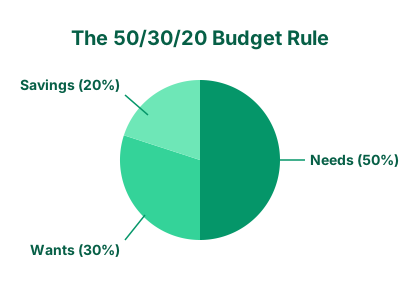
The 50/30/20 budgeting framework, popularized by Senator Elizabeth Warren, divides your after-tax income into three buckets: 50% for needs, 30% for wants, and 20% for savings and debt.
How Rent Affects This Framework
If you’re spending 30% of your income on rent, here’s how to adjust:
| Category | Standard 50/30/20 | Renter’s Reality (High Rent) |
|---|---|---|
| Needs (50%) | 50% | 60-65% |
| Wants (30%) | 30% | 15-25% |
| Savings/Debt (20%) | 20% | 15-20% |
The key adjustment: When rent takes up more of your “needs” bucket, you reduce “wants,” not savings. Your future self will thank you. Setting up sinking funds for irregular expenses like car insurance or holiday gifts keeps your monthly budget predictable.
Example: $3,000/month take-home, $1,100 rent
Needs (60% = $1,800): Rent $1,100 + Utilities $150 + Groceries $300 + Transportation $150 + Insurance $100 = $1,800
Wants (20% = $600): Entertainment, dining out, subscriptions
Savings (20% = $600): Emergency fund, retirement, extra debt payments
Read more: 50/30/20 Budget: The Complete Guide
Step 6: Roommate Scenarios
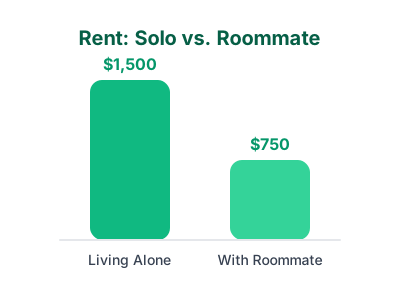
Living with roommates can cut your housing costs by 30-50%. According to Census data, nearly 30% of adults aged 18-34 live with roommates. It is not just normal, it is smart.
How Roommates Change Your Budget
| Expense | Solo ($1,400 Studio) | With Roommate ($1,800 2-BR Split) |
|---|---|---|
| Rent | $1,400 | $900 |
| Utilities | $180 | $90 |
| Internet | $70 | $35 |
| Monthly Total | $1,650 | $1,025 |
| Annual Savings | — | $7,500 |
Roommate Agreement Checklist
Before moving in together, discuss:
- How rent is split (equal? by room size?)
- Who’s on the lease (all of you, ideally)
- Utility payment responsibilities
- Guest policy
- Quiet hours
- Cleaning schedule
- What happens if someone needs to move out early
Red flag: If a potential roommate wants you to sign a lease they’re not on, run. You’d be 100% responsible for their share of the rent.
Step 7: Moving Costs
The actual act of moving costs money, sometimes a lot of it. According to Moving.com, the average local move costs $800-$2,000, while long-distance moves average $2,000-$5,000+.
Moving Cost Breakdown
| Method | Cost Range | Best For |
|---|---|---|
| DIY (rental truck) | $150-$400 + gas | Local moves, minimal furniture |
| Moving container (PODS, U-Pack) | $800-$2,000 | Long distance, flexible timeline |
| Full-service movers | $1,000-$3,000+ | Any move, hands-off experience |
| Friends + pizza | $50-$200 | Small local moves |
Hidden Moving Costs
Also budget for:
- Packing supplies: $50-$150 for boxes, tape, bubble wrap
- Security deposits for utilities: $50-$150
- New furniture/household items: $200-$1,000+
- Cleaning supplies: $50-$100
- Time off work: Lost wages if you can’t work remotely
Money-saving tip: Check Facebook Marketplace, Nextdoor, and Craigslist for free moving boxes. Grocery stores and liquor stores often give them away.
Step 8: Build Your Emergency Fund First
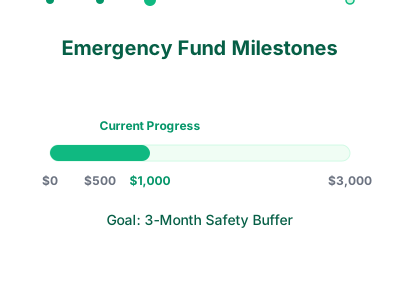
Here’s a truth bomb: You should not sign a lease without an emergency fund. The Consumer Financial Protection Bureau recommends having 3-6 months of essential expenses saved, but for your first apartment, start with a minimum of $1,000.
Why You Need This Before Moving
When you live alone, every emergency is your emergency:
- Car breaks down? Your problem.
- Hours cut at work? Your problem.
- Medical emergency? Your problem.
- Water heater bursts? Okay, that is the landlord’s problem, but you might need a hotel.
Emergency Fund Math
| Monthly Essential Expenses | 3-Month Fund | 6-Month Fund |
|---|---|---|
| $2,000 | $6,000 | $12,000 |
| $2,500 | $7,500 | $15,000 |
| $3,000 | $9,000 | $18,000 |
Realistic approach for first apartment: Aim for $2,000-$3,000 minimum (1-1.5 months of expenses). This covers most common emergencies without forcing you to put everything on a credit card.
Read more: How to Build an Emergency Fund from Scratch
Step 9: Sample First Apartment Budget Templates
Here are two realistic budgets based on common income levels for first-time renters.
Budget A: $35,000 Salary ($2,300/month take-home)
| Category | Amount | % of Income |
|---|---|---|
| INCOME | $2,300 | 100% |
| Needs (65%) | ||
| Rent (studio or room in shared apt) | $850 | 37% |
| Utilities + Internet | $150 | 7% |
| Groceries | $250 | 11% |
| Transportation (bus/gas) | $100 | 4% |
| Phone | $50 | 2% |
| Renter’s insurance | $15 | 1% |
| Minimum debt payments | $75 | 3% |
| Needs Subtotal | $1,490 | 65% |
| Wants (20%) | ||
| Entertainment/dining out | $250 | 11% |
| Subscriptions | $40 | 2% |
| Personal care/clothing | $100 | 4% |
| Miscellaneous | $70 | 3% |
| Wants Subtotal | $460 | 20% |
| Savings (15%) | ||
| Emergency fund | $200 | 9% |
| Retirement (401k/IRA) | $100 | 4% |
| Extra debt payment | $50 | 2% |
| Savings Subtotal | $350 | 15% |
Budget B: $50,000 Salary ($3,350/month take-home)
| Category | Amount | % of Income |
|---|---|---|
| INCOME | $3,350 | 100% |
| Needs (55%) | ||
| Rent (1-bedroom or nice shared) | $1,200 | 36% |
| Utilities + Internet | $180 | 5% |
| Groceries | $350 | 10% |
| Transportation (car payment + insurance) | $250 | 7% |
| Phone | $60 | 2% |
| Renter’s insurance | $20 | 1% |
| Student loan minimum | $150 | 4% |
| Needs Subtotal | $2,210 | 66% |
| Wants (20%) | ||
| Entertainment/dining out | $350 | 10% |
| Subscriptions | $50 | 1% |
| Personal care/clothing | $150 | 4% |
| Miscellaneous | $120 | 4% |
| Wants Subtotal | $670 | 20% |
| Savings (15%) | ||
| Emergency fund | $250 | 7% |
| Retirement (401k/IRA) | $200 | 6% |
| Extra debt payment | $20 | 1% |
| Savings Subtotal | $470 | 14% |
Common First Apartment Budgeting Mistakes
1. Forgetting About Utilities
Many first-time renters only look at the rent number. Then they’re shocked when their first electric bill arrives. Always budget 10-20% of rent for utilities.
2. Not Reading the Lease
Leases contain important details about late fees, guest policies, pet rules, and what happens if you need to break the lease early. Read every word. Ask questions about anything unclear.
3. Underestimating Moving Costs
Between the truck, boxes, cleaning supplies, and eating takeout for three days because you have not unpacked your kitchen yet, moving costs more than you think. Budget at least $500-$1,000 for moving expenses.
4. Skipping Renter’s Insurance
It costs $15-$20/month and could save you thousands. Don’t be the person who learns this lesson the hard way.
5. Not Building an Emergency Fund First
Living paycheck to paycheck in your first apartment is stressful and risky. Wait to move until you have at least $1,000 in savings.
Frequently Asked Questions
How much should I have saved before getting my first apartment?
Aim for $4,000-$7,000 total: $2,400-$3,600 for upfront costs (deposit + first/last month’s rent) + $500-$1,000 for moving costs + $1,000-$2,000 emergency fund minimum. If that sounds like a lot, that is because it is. Start saving now.
What if I can’t afford rent on my own?
You have options: get a roommate (cut costs 30-50%), look for a cheaper area, negotiate a longer commute, or consider staying with family a bit longer while you save. There’s no shame in waiting until you can truly afford it.
Should my rent be 30% of gross or net income?
The traditional rule uses gross income (before taxes). But since you pay bills with take-home pay, many experts recommend using 30% of net income instead, or 25% of gross. Either way, lower is always better.
What bills do first-time apartment renters pay?
Expect to pay: rent, electricity, gas (if applicable), water/sewer (sometimes), internet, renter’s insurance, phone, and possibly parking. Some apartments include certain utilities. Always clarify before signing.
Can I negotiate rent?
Sometimes! In markets with high vacancy rates, landlords may negotiate. You can also ask for: free parking, waived pet fees, or a free month’s rent. The worst they can say is no.
Next Steps
- Calculate your take-home income using the method in Step 1
- Use our First Apartment Budget Calculator to see if you can actually afford that apartment
- Open a “moving fund” savings account and start saving
- Check your credit score. Landlords will
- Start browsing listings to understand your local market
Related Content
- First Apartment Budget Calculator — Find out if you can afford that apartment
- 50/30/20 Budget Guide
- How to Build an Emergency Fund from Scratch
- How to Stop Living Paycheck to Paycheck
- Best Budgeting Apps 2026
- How to Make a Budget: Complete Guide
- Sinking Funds Guide
Sources
- U.S. Census Bureau, Median Gross Rent Data (2023)
- U.S. Department of Housing and Urban Development (HUD), Affordable Housing Guidelines
- Consumer Financial Protection Bureau (CFPB), Budgeting Resources
- Bureau of Labor Statistics, Consumer Expenditure Survey
- Zillow Research, Housing Market Data
- Insurance Information Institute, Renter’s Insurance Statistics
- Warren, Elizabeth & Warren Tyagi, Amelia. “All Your Worth: The Ultimate Lifetime Money Plan.” 2005.
Disclaimer: This content is for educational purposes only. Budget recommendations are general guidelines and may not fit every situation. This is not personalized financial advice. See our full disclaimer.